Audience or Journalism Development?
My name is Lars K Jensen, and I work with journalism, data and editorial insights as the Audience Development Lead at Berlingske Media in Denmark.
Feel free to connect on LinkedIn and say hi.
AUDIENCE DEVELOPMENT LEAD. That's the title for my current job at Berlingske Media in Copenhagen.
A title as that much more common that it would have been a handful of years ago, especially in the Danish industry.
But as the "audience" discipline with its focus on users and their perspectives and experiences continues to grow and evolve in the media and publishing industry, job titles with the A-word in them are obviously increasing.
That makes perfect sense. Caring about your audiences and implementing a better understanding of who they are and what they are trying to achieve will benefit any publisher.
Plus, working with audiences is insanely fun.
For the past few months, though, I have been pondering - perhaps even meditating - on my job title.
The reason is this: The more I work with audience development, the more I realize that we are in fact developing content.
That we are developing stories.
That we are developing journalism.
That's not bad. Not at all. In fact it's probably quite the opposite and just the right place to build sustainable development.
But the thought process made me reflect on what it is I really do. And whether it also says something about one of the most important trends and currents in our industry right now:
As the publishing and media industry begins working with audiences and audience development, are we in fact developing our own journalism at the end of the day?
And if we are (as I would argue) does it matter how we organized our audience development work? (Spoiler alert: yes, it does.)
Let's dig in.
The handshake seals the contract
Recently, I've developed a habit which I would recommend to all of you out there who are writing as well:
Before I finish an article for this newsletter (sometimes even before I start) I share my thoughts behind it in a LinkedIn post. Not only does it force me to present the idea in a coherent way - it's also a test whether I am alone with that thought or assumption, and whether it's any good.
The text now in front of you now is no exception.
I presented my reasoning in a LinkedIn post where I wrote:
"The more I work with user needs and other audience-first approaches, the more I learn how inseparable they are from the journalism we are producing — which is providing value to our audiences and customers.
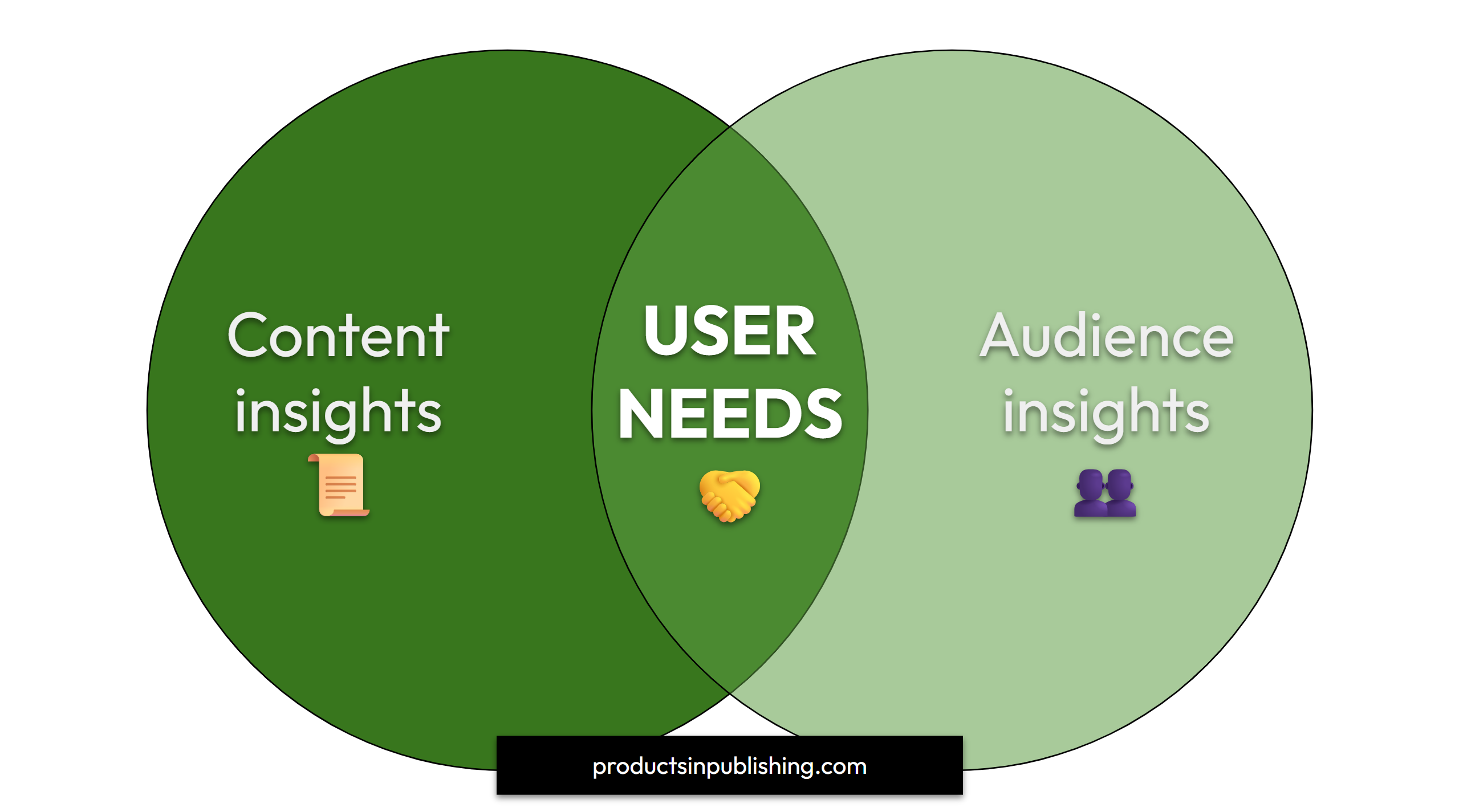
The user needs approach (which I spend a lot of my time and mental resources on) live right where the handshake between journalism and audiences happen.
That’s so powerful. But it also means you need to think about how you more forward from there. [...]
A lot of other audience people I talk to and hear from also spend a considerable amount of time and resources on finding insights — and feeding them into the editorial workflows and journalistic part of the organisation."
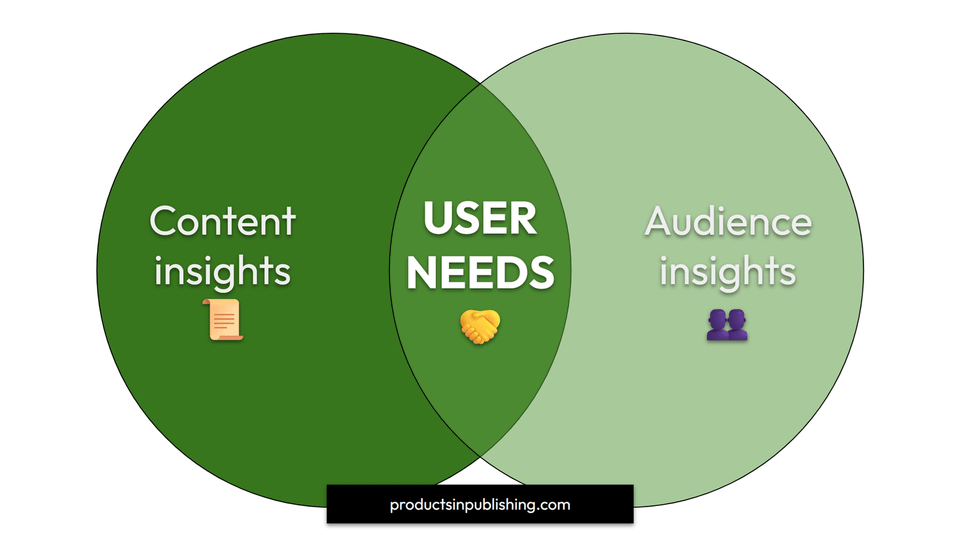
If we try to visualize what I mean by the handshake between journalism and audiences, it could look something like this:
Standing on the shoulders...
One of the persons who joined in on the conversation on LinkedIn (and huge thanks to all those of you who did) is Dmitry Shishkin.
Dmitry is a towering figure in the world of user needs - as he was the one who invented the method while he was at the BBC back in 2018.
Since then, he has refined his original work into a user needs 2.0 model together with the good people at Smartocto, as a way of combining the various user needs models out there in a coherent structure.
He is still a huge part of the continuing development and adoption of user needs across the global industry - and he wrote a very insightful comment (with my edits for clarity in [brackets]):
"In my Nieman Lab prediction for 2025, I made a point, that newsrooms got it wrong when they introduced audience development teams as separate units from (or even within) newsrooms.
It's good that they did introduce it, but it sent a message that [audience development] is someone else's job. If someone develops audience, and someone does editorial separately, this is not going to change anything, so the faster we merge them, the better.
I'd go [one] more and say that [audience development] people are better suited for modern newsroom leadership, at least this is how I see their career progression."
That "it's someone else's job" is probably something that a lot of you out there will hear and/or sense, whether you are trying to implement user needs, audience insights, technology or something else into newsrooms - or other types of organisations for that matter.
In a response to Shishkin's comment, Stuart Rowson (founder of Lucky Sucks Media and previously with the BBC) wrote:
"And here’s the thing too… journalists need to be audience developers.
If you’re still trying to tell stories in the same way you were trained 5, 10 or 15 years ago, then you’re missing the point.
I see too many journalists who are stuck in the same way of telling stories, without realising that adapting to audiences needs and developing their storytelling is a fundamental part of being a good storyteller in the first place."
Another insightful comments came from Dr. Ole Fehling, who is leading the DRIVE initiative, a collaboration between Germany's DPA, business consultancy Highberg and 30 regional publishers from Germany, Austria and Switzerland to boost digital subscriptions):
"Journalism is only relevant if someone consumes it, as Jens Pettersson pointed out. What is the value of a story if no one listens to it (and who should then pay for its creation)?
Therefore, audiences and their needs must be central to any newsroom strategy. The User Needs approach is so successful because it elegantly bridges the gap between journalism and audiences. It connects a piece of content to its audience either by shaping the storytelling to meet audience needs or by commissioning content based on specific needs from the audience.
However, if you focus solely on an audience-first strategy and only react to what the audience demands, there is a significant risk of merely surfing trends. To avoid becoming easily replaceable in the digital world, a newsroom must also build a strong news brand that stands for something. This requires setting its own agenda—choosing which topics to cover, from which perspectives, and in which formats.
Thus, it is crucial to listen to and build audiences, but equally important to develop your own "style" of journalism—both in alignment with audience needs and your brand strategy. Ultimately, it's a co-development of audience and journalism that leads to lasting success.
At DRIVE, we believe that in the future, journalism and audiences might converge and become increasingly indistinguishable. As community aspects gain importance, both journalists and audience members will create and engage with content collaboratively. In this future, "content" will be produced together, and audience development and journalism development will increasingly merge into community development.
Amen.
(The Jens Petterson mentioned is the Head of Editorial Development at Sweden's NTM and their work on collaboration with newsrooms ("Friendly SWAT teams") recently won an INMA award.
He also had some insighful comments in the LinkedIn conversation, so be sure to head in there once you've read this post to the end 😉)
Francesca Dumas (co-founder of Contribly) wrote about how she believes we need to take a few steps backwards:
"I think we need to go back to basics, and the question is does our newsroom have a common definition of what we do?
The basics in business:
What is the problem you are solving? (User needs answers some of this)
Who are we solving this problem for?
What is the ‘product/service’?
Then above this, the mission - why do we do what we do? What is the ambition? What is the big picture we are trying to change?
In news, we are great at the ‘Mission part’ - My mission is to inform and hold power to account. And then we sometimes skip straight to journalism = content. We separate out the ‘audience part’...
All of these questions are intertwined. It’s not ‘journalism on one side, and audience on the other’.
Journalists have always been good at building relationships, it’s a core skill (find and initiate the story, connect with the people who can help you tell it and connect with those that need to hear it to make a difference) … it’s the transition into doing this in the digital world that we are struggling with… so much of the humanity is taken for granted.
To be a journalist is to be an initiator of conversation, except now we have the power to keep the conversation going, instead of writing about it and moving on to the next topic."'
What's the next stage?
It probably won't surprise anybody, that a screenshot of Dmitry's comment made it's way into my standard presentation on user needs, when I talk about how we at Berlingske (a newspaper published since 1749) approached, analysed and implemented user needs.
But it also got my head spinning.
I work in the commercial department at Berlingske Media (where we also publish three other titles), so I am one of those Dmitry writes about as separate units.
One day a week I, for now, sit in the Berlingske newsroom and work there, which does a lot of good but doesn't exactly merge me with the newsroom. Soon it'll probably be two days a week, but the challenge (and the risk of people thinking that it's "someone else's job", to quote Dmitry) remains the same.
Now, my job will most likely remain on the concern/corporate side of things, but what Dmitry tells us is absolutely true and is a factor and risk I have to work with and mitigate, every single day.
So what does the next stage look like? That's the question I am asking myself – and whoever wants to listen 😄 – almost constantly.
How the pros do it
As I learned in a recent INMA webinar, they have a tighter integration and collaboration at The Wall Street Journal than I think I have ever heard about.
Here, Tess Jeffers (who is the Director of Newsroom Data and AI at the WSJ) and Fernanda Braune Brackenrich (who leads the Financial Times' audience engagement team in the United States) gave examples of how they work with their reporters and editors.
(They gave a similar presentation at The Online News Association's annual conference last year, and you can see the slides from that presentation [PDF, 33 pages], if you are curious.)
They talked about "shifting left", which basically means that insights need to applied as early in the journalistic process as possible:
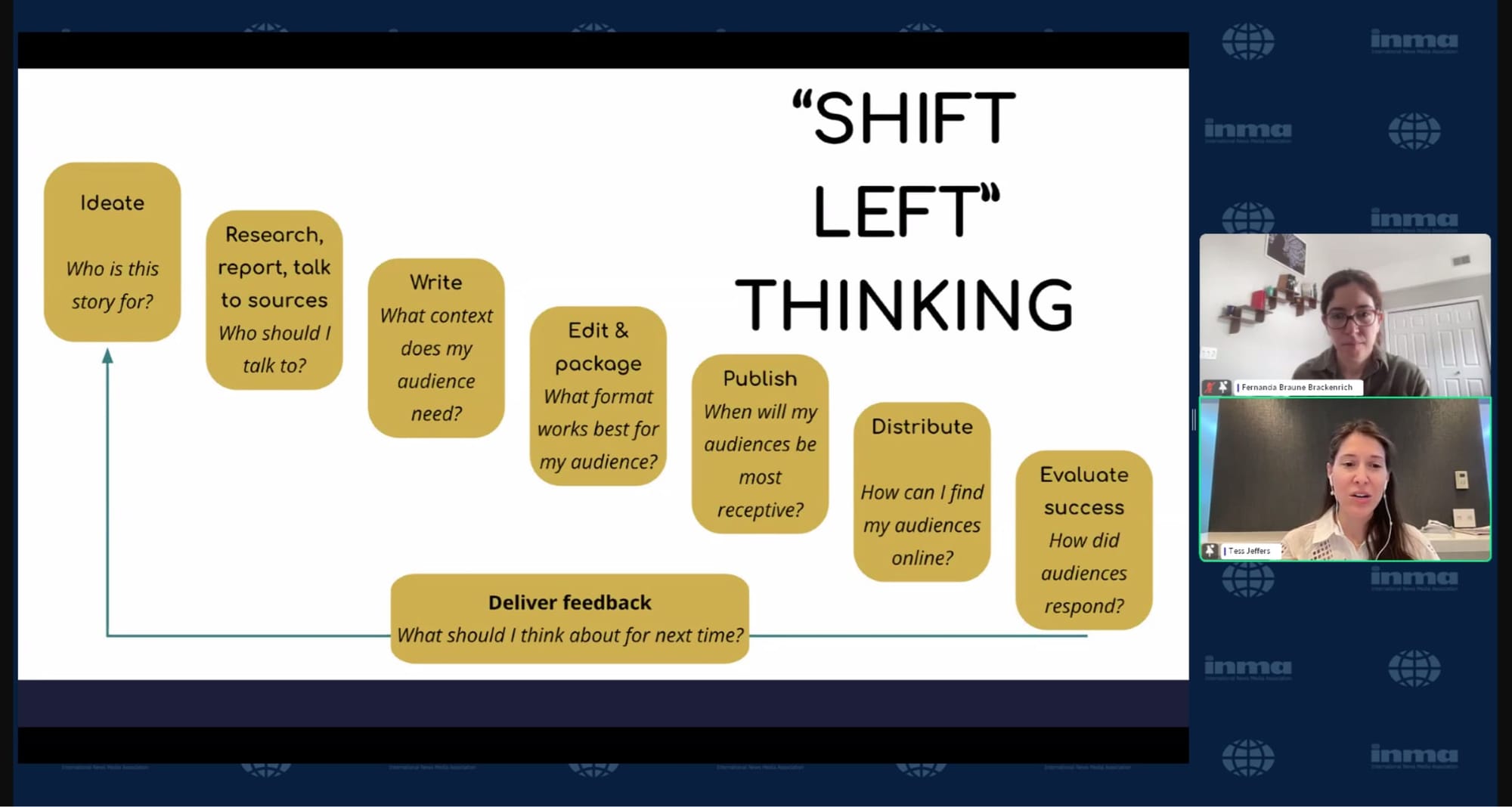
The most interesting part of the webinar for me was then Tess talked about how and when they present insights to the newsroom:
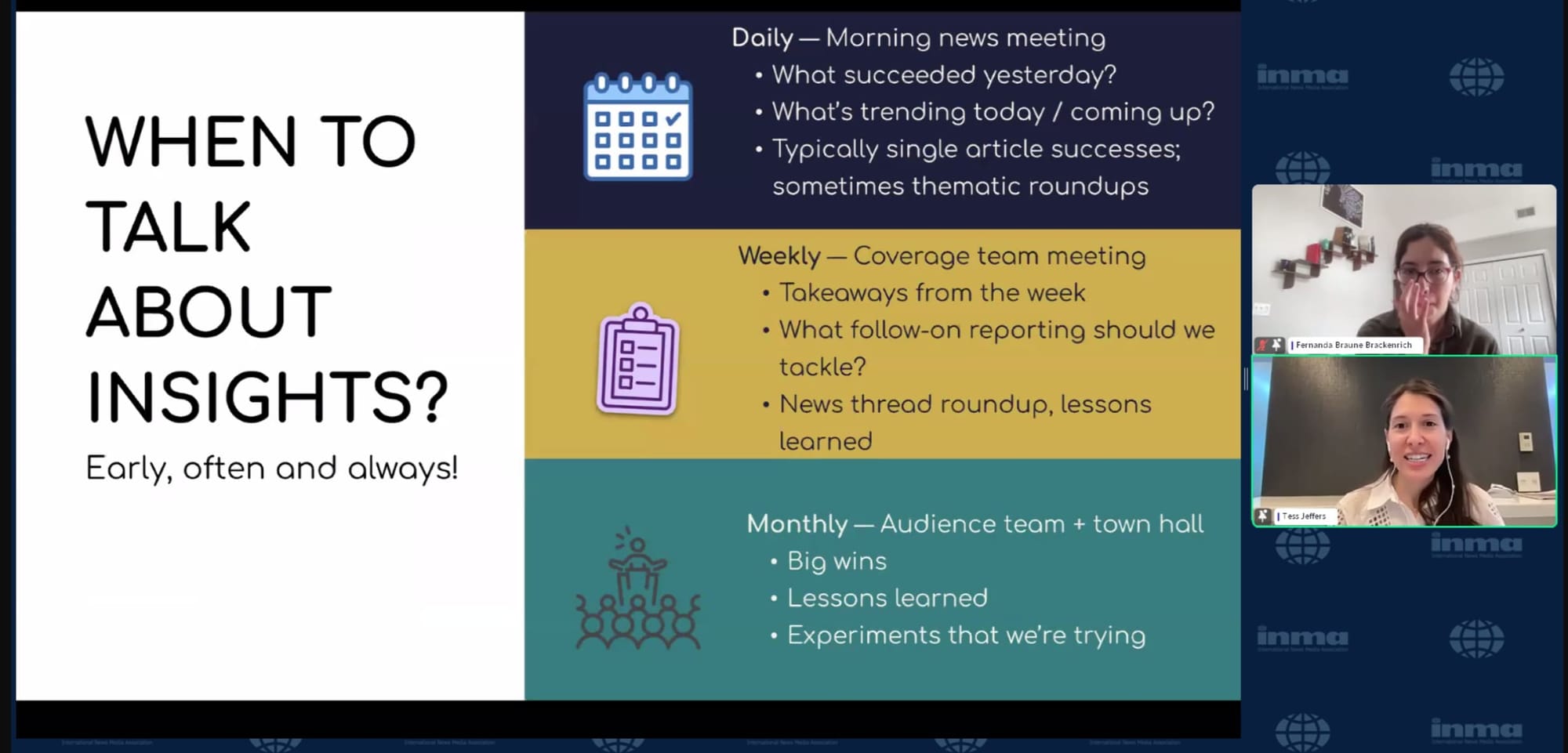
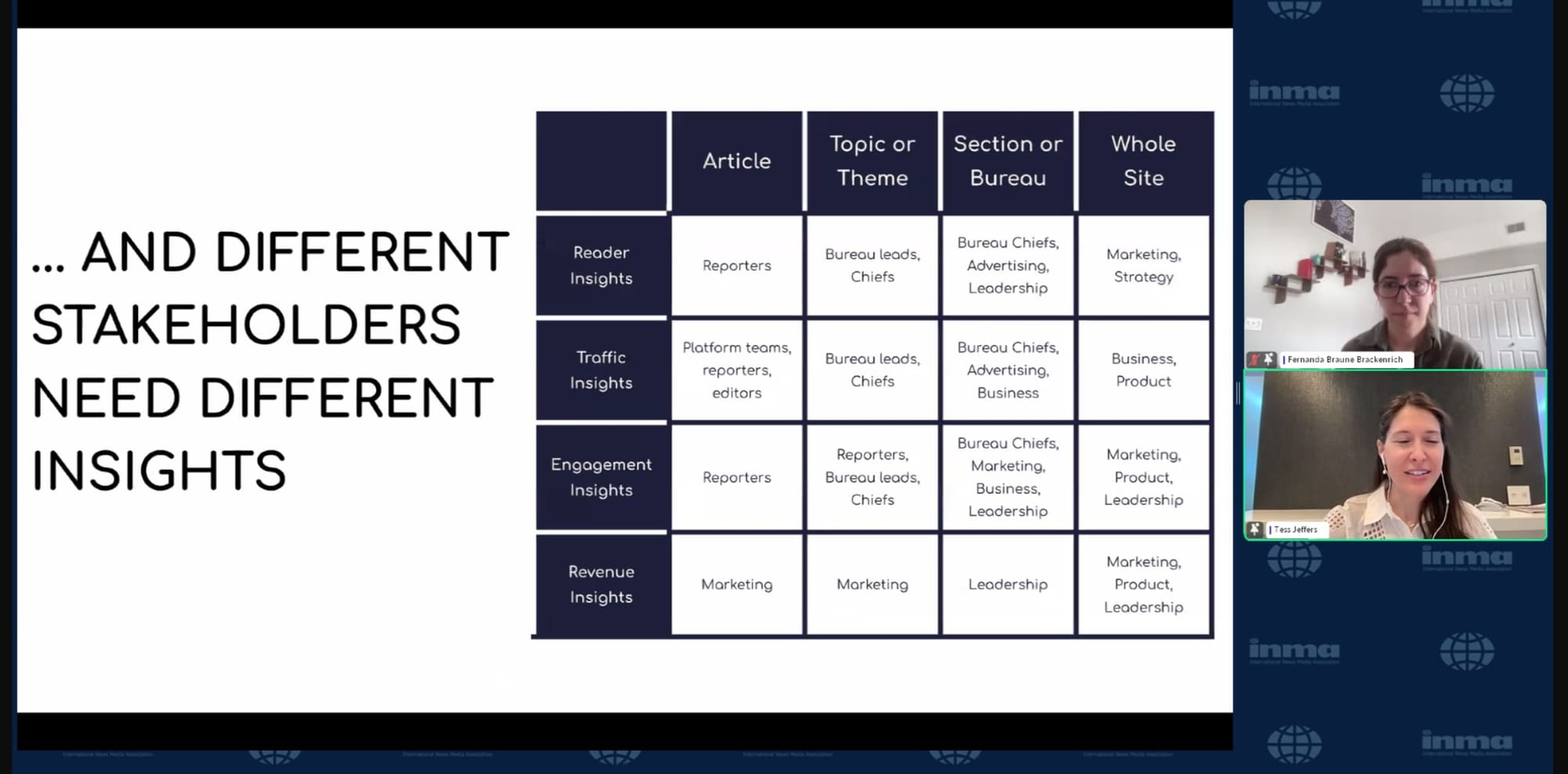
This is a direction I can see us moving in. It puts the audience work (and the important insights based on the data footprints left behind by our users) center stage for reporters and editors.
So if you ask me, this could be an important part of the next stage; the people with the insights presenting and in conversation with the people who can truly act on those insights.
And Tess' and Fernanda's excellent webinar supported my hypothesis, that we are in fact developing our journalism when we set out to implement actual audience development.
Which is a good thing.
Let's draw it!
Now, let's take my visualization on how user needs exist at the handshake between journalism and audiences from earlier.
And let us update it with the belief that audience development is – at the end of the day – journalism development.
Then we end up with something like this:
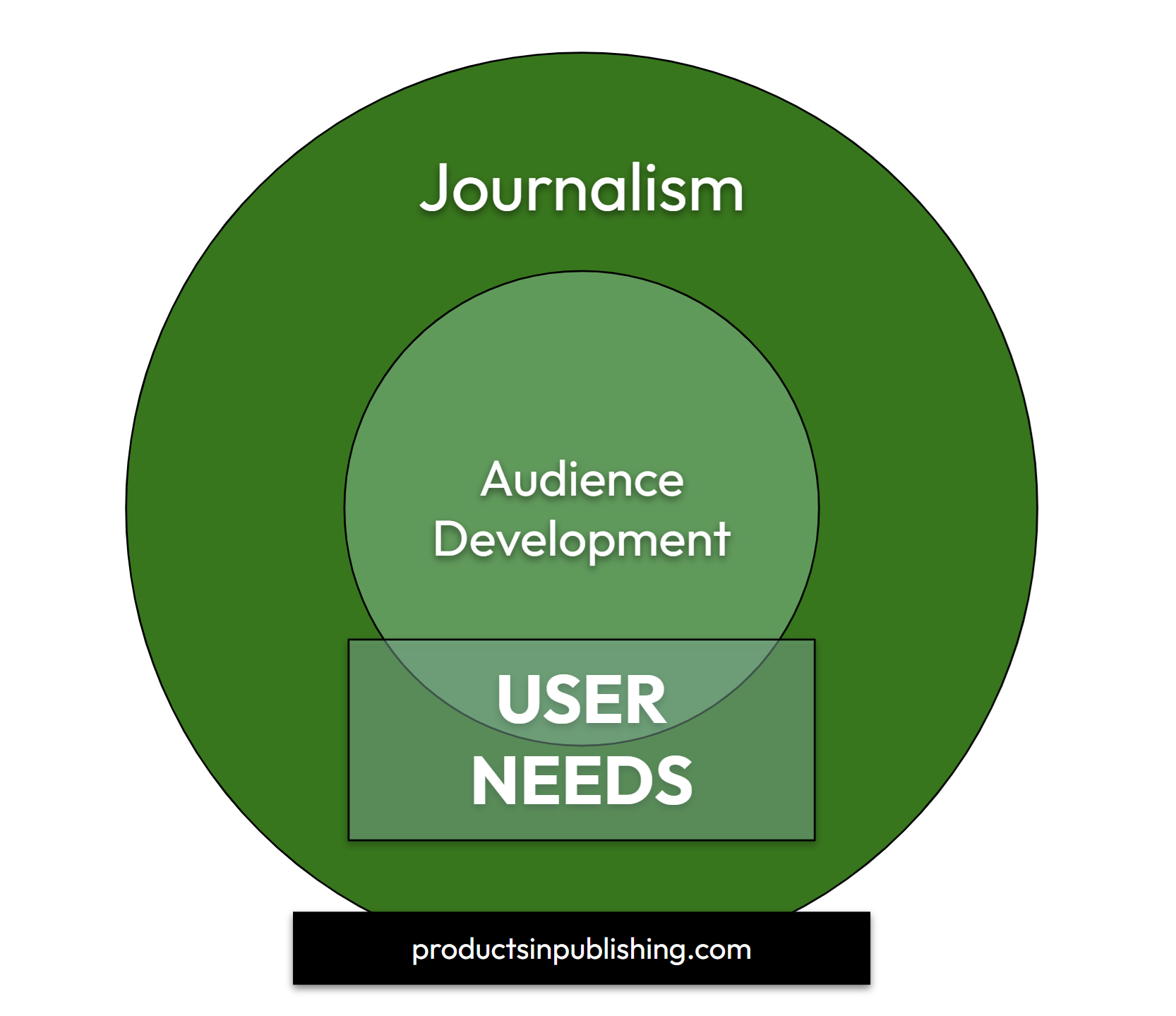
Yes, there obviously are some disciplines within audience development which aren't naturally a part of journalism but more on the business side of things.
But in terms of the conversations and development happening in the industry now and going forward, I think that visualization is pretty accurate.
This also highlights why:
- People working with audience development need to work extremely close with newsrooms.
- Reporters and editors need to approach audience development as something that is inherently a part of their now – and not someone else's.
- Members of newsrooms and members of audience development teams need to come together in a shared understanding that they are working towards the same goal ultimately: Better, more relevant and more valuable journalism.
It this new? Not at all. As research at the Tow Center for Digital Journalism and the Shorenstein Center showed in 2019, we need more collaboration across the various departments in an organisation. The conversation then was about conversions and paywalls, yet the points remain the same when we talk about audience and journalism development:
"Producing those products, managing their marketing, and getting readers 'down the funnel' from simply engaging with the news organization to opening their wallets, requires tight integration between product designers, audience growth managers, social media producers, and editors and reporters in the newsroom.
Yet our data suggest that publishers whose corporate structures house product and analytics functions in centralized parts of the organization, even while their newsrooms are decentralized, have difficulty fostering the kind of on-the-ground, close-to-the-reader collaboration between disciplines needed to make a reader revenue strategy really work."
The major challenge for many remains the same: To enrich and develop the layout of media organisations to facilitate collaboration and better stories, products and services. 🏁
My name is Lars K Jensen, and I work with journalism, data and editorial insights as the Audience Development Lead at Berlingske Media in Denmark.
Feel free to connect on LinkedIn and say hi.