Structure Isn’t Everything – It’s Not Even Enough
My name is Lars K Jensen, and I work with journalism and editorial insights as the Audience Development Lead at Berlingske Media in Denmark.
Feel free to connect on LinkedIn and say hi. I'm also on Bluesky and I publish a weekly newsletter called Digital Ugerevy.
CHANGE IN ORGANISATIONS. I think all of us have been involved in change work at our workplace at one point or another.
If you've ever been involved on a more managerial or planning level, you'll probably know that "structure" is usually one of the first things that come up. Changing the existing structure (often represented by the organisation chart) is almost always a guaranteed part of the solution.
As long as the structure is good, everything will follow and success is as good as inevitable, right?
Wrong. That is probably not the best place to start.
In this article, I'll tell you about an interesting way to look at organisational chance and how to drive it. Something which been instrumental in how I think about implementing change in organisations – especially user needs into newsrooms.
A deeper dive
I have previously written about our work on implementing user needs at Berlingske, a 276 year old newspaper (and how it is culture change), so this article is a deeper dive into one of the many elements of that equation.
A few years ago I came across a Harvard Business Review article titled The Secrets to Successful Strategy Execution which gave me some interesting insights I have used ever since.
The topic is strategy execution and the article is based on data gathered from real-life organisations over the course of four years. But even if you feel like you aren't necessarily "executing a strategy" (if you are implementing or working with user needs I would argue that you are in fact executing a strategy, though) there's a good chance that you can still extract something from it.
Four fundamentals
The authors have gathered data from organisations on what works when executing a strategy and divide it into four fundamentals - one of them being "structure", which we talked about earlier.
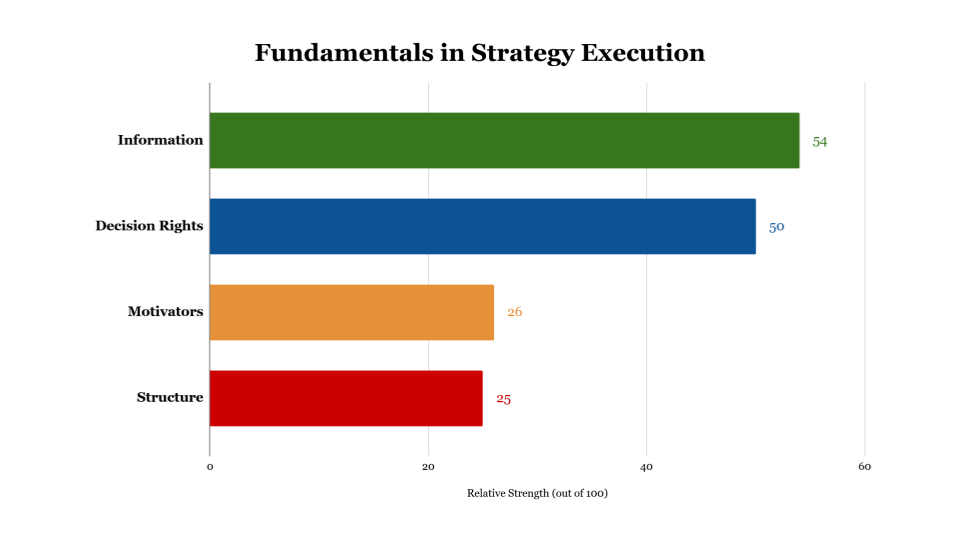
But if structure isn't the impost important area of focus, what is? You need to start somewhere else, as you can see in this chart:
So instead looking at structure as the first thing, we should focus on:
🟢 Information: Does data and information flow freely across the organisation so specialists, managers, people on the frontline etc. always have correct and updated data to act and decide upon?
🔵 Decision Rights: Do you and your colleagues have a good idea of who is responsible for a given decision, and can decisions be made without too much second-guessing and without too many decision-less meetings?
This is a huge topic, but if translated into implementing user needs into a newsroom, it can look something like this:
🟢 Make sure your colleagues have access to data and insights showing how and when working with user needs can impact both the journalistic and business side of things - and remember that different roles can need different data.
And by "access to data and insights" I don't just mean that you should just build dashboard and data reports and hope your colleagues remember to look at them.
Make sure to (especially in the early days) communicate directly with them; send them emails, show them the insights and tell them why they are important - and listen to what they have to say to you.
Means vs. end goal
It's not just about implementing user needs in a newsroom. That's the means.
The end goal is about achieving the improved impact, value exchange or (let's face it) revenue that you stand to gain from implementing user needs in your organisation.
Data is a prerequisite for this decision to be made properly and if you are in possesion of those key data and insights, you need to set them free.
When information flows more freely across your organisation it will also be easier to delegate what the authors call "operational responsibility to the people closer to the action", which is crucial in achieving what we're striving for.
🔵 Who's responsibility is it that a publication or a part of your editorial organisation works with user needs in a given way?
And who needs to do something, if the intended impact isn't happening - or the necessary changes aren't implemented?
In the end, it's about people, responsibility – and mandates.
My suggestion
If you are about to start out with user needs and want to increase your chances of adoption in your organisation, I'd say that the "Information" part (even though they are all linked and decision rights need to be supported by available information) is a great place to start.
If you want to implement something as potentially all-changing as user needs, you need to have a very clear narrative about what you as a publisher and the editors and reporters stand to gain from it. Otherwise, why would they want to do anything differently?
When I'm talking to other publishers and organisations about our work with user needs at Berlingske and how we got it started, this is a point I emphasize.
If you want your organisation to start working with user needs, don't just show up with the model and tell everybody how cool it would be. You need to do the first tagging and analysis first and present that along with the model and idea behind working with user needs.
...and keep 'em coming
And once you've got those information flows and channels established, you need to make sure that insights and data keep flowing through them.
This is a very important part of tracking the progress, successes and failures when the newsroom start to actually bring user needs into the journalism.
This is one of the reasons why I do an internal newsletter and make sure to constantly communicate insights and learnings to the people who can act on them. This is also where "decision rights" comes into the picture and makes it all come together.
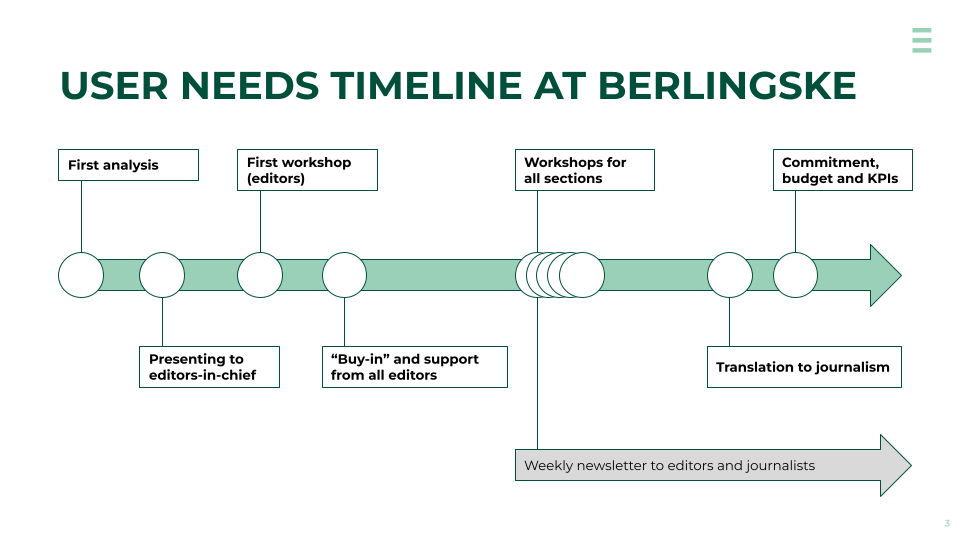
I have shared this timeline of the user needs implementation af Berlingske before, and the key parts in the context we are talking about here are "First analysis" and "Weekly newsletter":
An important question
When I'm out and about talking about our work with user needs at Berlingske, I dedicate the last part of my talk to this specific topic and finish by asking this question to the audience:
"How will you make sure that the relevant analyses, learnings, messages etc. around user needs can get to the right people at the right time?"
Having an answer to that question will make the implementation a lot easier and greatly increase your chances of success.
It's about getting decision to the right places to make the right decisions to end up at the right place.
And if you can't make the right people to act on the right data and commit to the right changes, you've got a problem. So in a way, this way of thinking can also be used to spot symptoms of an unhealthy organisation or implementation.
Thank you for your time.
My name is Lars K Jensen, and I work with journalism and editorial insights as the Audience Development Lead at Berlingske Media in Denmark.
Feel free to connect on LinkedIn and say hi. I'm also on Bluesky and I publish a weekly newsletter called Digital Ugerevy.