What Is Your Collegial Value Proposition?

My name is Lars K Jensen, and I work with journalism, editorial insights and digital development as the Audience Development Lead at Berlingske Media in Denmark. This is my personal newsletter.
Feel free to connect on LinkedIn and say hi.
In this post I'll let you in on one of the most important things I learned when I worked as a consultant in the media industry a few years ago – and no, it's not about AI.
Executive summary:
Understanding your colleagues is just as important as understanding your customers. Just as businesses develop value propositions around customer needs, we should consider how we create value for the people we work with. This starts with understanding their Jobs To Be Done, pains, and gains — and the context in which they work.
Colleagues have different priorities, pressures, ways of communicating, and relationships with management. Understanding these differences makes collaboration easier and helps us create value for one another. Sometimes, something as simple as adapting how we communicate or helping a colleague keep their boss informed can make a significant difference.
The Value Proposition Canvas offers a practical way to turn this understanding into action. By researching colleagues' needs, identifying how we can address them, and translating those insights into concrete activities, we can develop a stronger internal value proposition.
Another approach is to apply the user needs method to our coworkers, using it to understand and address their needs just as we would those of our audiences. Both approaches ultimately encourage us to make curiosity about our colleagues a natural part of how we work.
(Written by ChatGPT, approved by the author.)🎧 Are you more of a listener than a reader?
Then you can spend ~20 minutes listening to two AI voices dive into the article below (although they are quite over-selling the idea, if you ask me 😂) – generated by Google's Gemini Notebook:

What is value, really? That is a big question and the easy answer is obviously that it depends a lot on who you want to be valuable to.
Every conversation around value needs to begin and end with your audience – or users or customers, whatever you prefer to call them. And in order to talk about your value to them it's helpful to define a value proposition.
Basically, your value proposition(s) is where you strategy comes to life and meets your users.
I imagine that quite a lot of you are already following Mattia Peretti's amazing News Alchemists newsletter (if you aren't already, you need to).
He recently wrote about the importance of having a value proposition.
Mattia leans into an article from the Membership Guide on value propositions – and they recommend this template from Strategyzer (who also invented the Business Model Canvas):
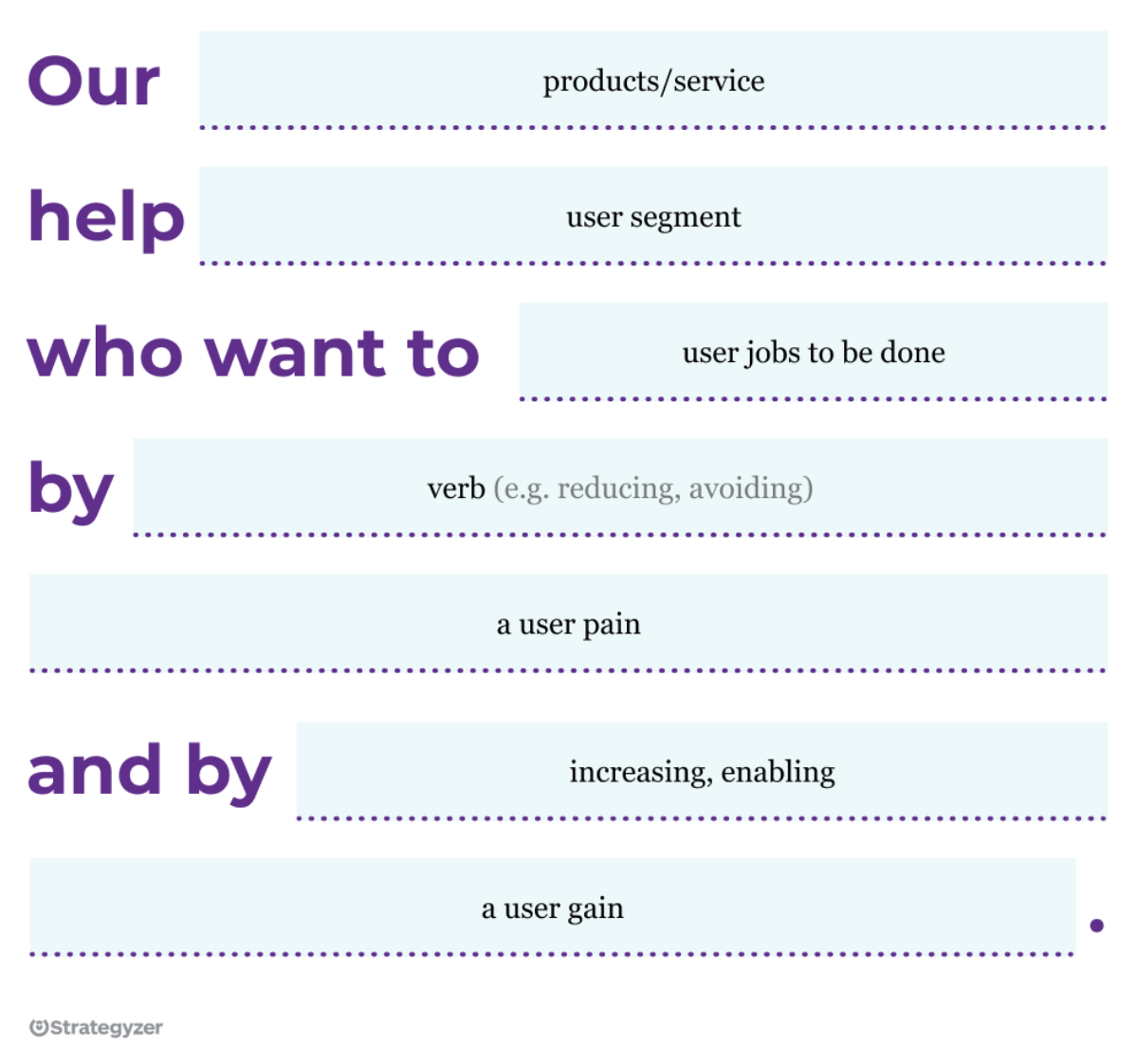
This template is great in that it answers the most important questions. But if you ask me, this is better for when you have the foundation and done the necessary research and ideation in order to talk about your value proposition.
I prefer the Value Proposition Canvas (which the article also references), by Strategyzer as well, because it invites to discussion, questions (that need answers) and a bucket load of post-its 😄
Here's how the canvas look in all its beautiful simplicity:
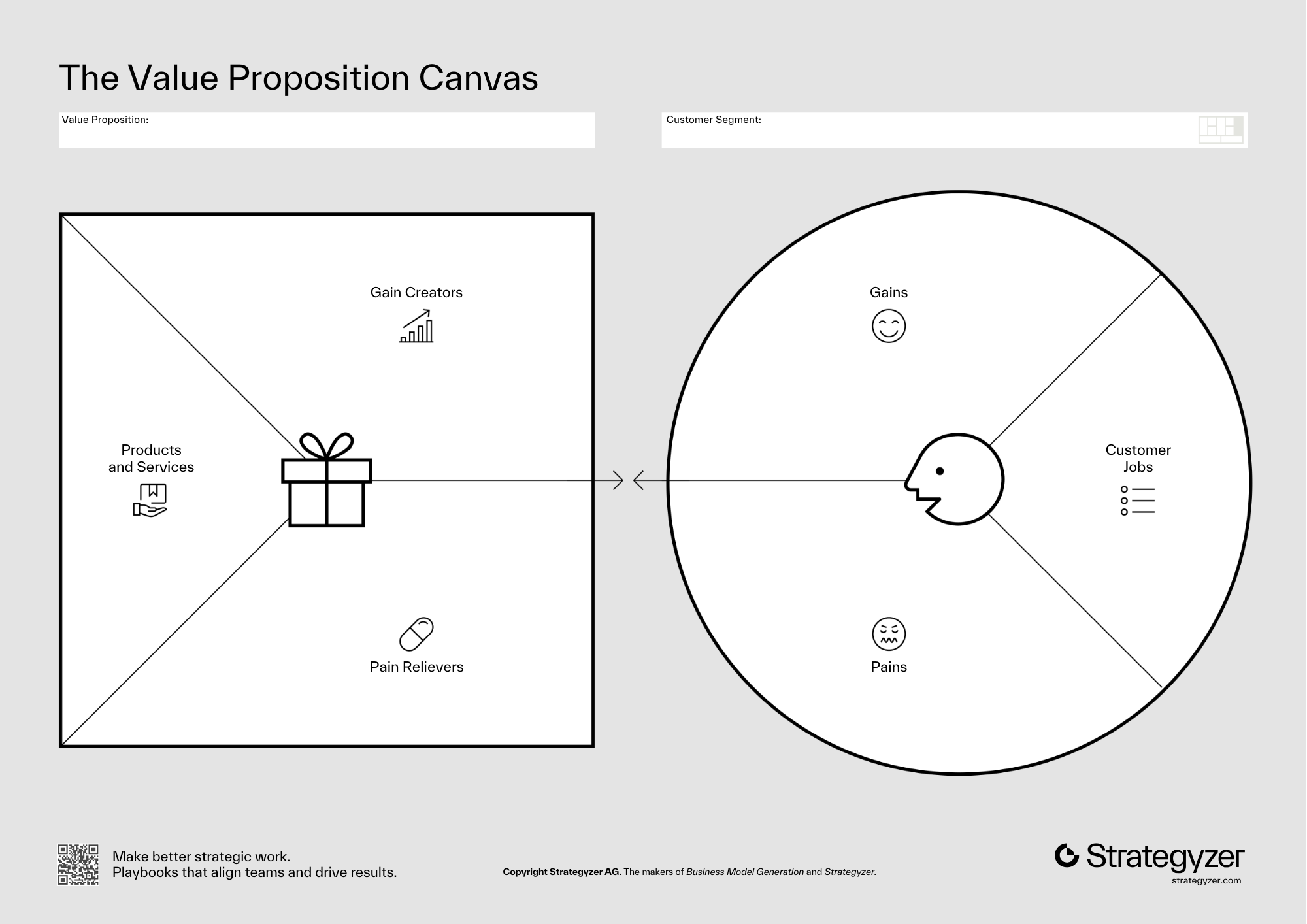
When you work with the canvas, you always start on the right hand side. Remember that.
Here's a brief explanation of the three fields in the circle above:
- Customer Jobs - also called Jobs To Be Done: This is the tasks that your audience are trying to get done. For news media it could be "stay on top of the news", "be part of conversations at lunch" etc.
- Pains: What your users are struggling with – either in general or when using your product or consuming your journalism. "Not enough time" usually pops up here – but it could also have to do with your design, use of formats etc.
- Gains: This can be a little bit tougher to define, but I usually say it's what the user experience when a job is done 😊 So it's the reasons why people follow the news, for instance – what they hope to get out of it.
Before filling out the canvas, you'll usually be talking to your users, looking at data (usage, surveys etc.) so you both have quality and quantity covered.
Users needs = Value proposition
Talking about your audience's pains, gains and Jobs To Be Done is the basis for your value proposition. If what you set out to create doesn't match your users and the context they will consume your content or use your product in, you are heading in the wrong direction.
I like to show the canvas whenever I'm introducing someone to user needs (a favourite topic of mine), because that is exactly what your user needs model and vision should be:
It's your value proposition to your audience, put into a structure that actually fits into the day-to-day life of a newsroom – because let's be honest, the canvas doesn't.
Jobs To Be Done is a whole, amazing, framework in itself. But in my experience, working with Jobs To Be Done in order to include it in your Value Proposition Canvas is the best way to do it in a more practical form and direction – where you actually end up building or publishing something for your audience.
I will, however, recommend you to think about the context (for instance time of day, location, choice of device etc.) of your users' Jobs To Be Done – and talk about the difference between functional, emotional and social Jobs To Be Done.
Those are some of the core parts of that framework and important things for you to consider.
Let's begin
Okay, so now we have sort of established what a value proposition is. We've looked at a few tools and I've told you my favourite approach – and recommended you to follow one of my favourite newsletters.
✅ Check.
This means that it's finally time to dig into the topic I want to talk about.
Because obviously it's important to know your users and have a product-market-fit-magic-sparkle-sparkle value proposition.
But if there's one single thing I've learned again and again – both from being part of organisations and working as a consultant, it's this:
💡 Be very, very aware of your collegial (or internal) value proposition.
Now, I don't mean internal as inside your body – but as inside your organisation, towards your colleagues and others you might be working with.
Because we all have pains, gains and Jobs To Be Done which make us users of something, also when we are at work.
We have things we need to do for various reasons (Jobs To Be Done), things that make us happy (gains) – and things that annoy us to pieces (pains).
A few examples from my work life:
Jobs To Be Done:
- Keep editors and reporters in the loop about how their stories are performing.
- Stay on top of digital media trends and technology (for instance AI).
- Work with and give advice to editors and heads of editorial development.
Pains:
- People are busy.
- It's very hard to stay ahead of the curve in trends and AI development.
Gains:
- When a piece of insight and/or advice leads to more valuable, better performing journalism.
- When we can successfully mitigate an emerging threat.
An important part of your success in whatever role you have in your organisation relies on you knowing this about your colleagues. And acting on it, obviously.
Collaboration is so much easier if you know just a little bit about your colleagues and where they are coming from, and vice versa.
And sometimes you end up relying on others in your organisation to do something, talk to someone etc. (This is especially true if you are in a bridge role.)
So a little bit of knowledge goes a long way.
Should you write or talk?
Another quick example:
I think everybody knows that our users are strapped for time, which affect how much time they have to read your longreads. This is part of the reason why some publishers want to write shorter articles and some expand to audio (same Job To Be Done, different context).
But I'll bet that the same goes for your colleagues. So maybe you ought to write shorter, more to-the-point emails (I certainly have room for improvement here).
And we can dive a little further into that example.
Management guru (I never use that term, but it applies here) Peter Drucker famously asked us to reflect on whether our boss is a reader or a listener. That says a lot about how that person best absorbs knowledge.
And it's something you should lean into in your communication with your manager.
The same goes for your colleagues. Some prefer to read, others to listen. And sure, you can try to find out using split test and what-not – but maybe it's easier to just ask them.
And the list goes on.
What the boss wants
Here's an interesting thing I first came across this when I did customer interviews for a media monitoring company I worked for years ago.
We found out that one of the most important things for our most important customers (this was a business-to-business, BtB, product) was as simple as it is obvious:
👔 Keep the boss happy.
And this was true whether we talked to people "on the floor" or in the C-suite.
Keep the boss happy. Help him/her:
- Stay in the know
- Ahead of the curve
- And look good
...without wasting precious boss time.
The same goes for your colleagues. A huge part of the their job success (and security to some) is intertwined with their relations with their boss.
Some call this "managing up", and getting things done is easier if you find out how others are managing up. It can be in your team, department or across the organisation.
We all do it, and if you play your colleagues to their strengths and make it easier for them to manage up, you are creating a runway for whatever you are working on together.
It's the same reason why it's usually a good idea to share with your colleagues when you see or hear about something that could be valuable for them to know (and tell their boss about).
Your coworker's boss can be in his or hers Jobs To Be Done, pains and gains.
Different strokes for different folks
It's obviously harder to do this across larger organisations, because you'll likely be working with people from parts of the organisation that is very different from yours.
This is for instance where some people fail when trying to work with newsrooms (and where some newsrooms fail to work with "outsiders").
There's a good chance that your newsrooms run in a different way than your, say, commercial, development or financial departments do. It's supposed to be that way.
This means that the reporter or editor in the room with you can have a very different way of managing up (or down, for that matter) – and this is part of the understanding you need to have of that person and others.
Think about the context your colleagues exist in is very important. Do they have a lot of meetings? What will they do when they sit down in front of the computer? What does success look like to them? And to their boss?
And it's best to have some sort of structure for this way of thinking.
Which means it's time to bring out an old friend:
It's canvas time!
The beautiful thing about the Value Proposition Canvas is that it's just as perfect for this way of thinking as it is for your outbound value proposition.
So I would recommend that you do exactly the same things as if you were working on that: Research.
✅ Your to-do list:
- Talk with the people you work with the most.
- Talk with others who work a lot with the people you work with the most.
- Talk with others who have the same manager you have.
- And talk with your own manager.
- Identify Jobs To Be Done, pains and gains.
After doing that, it's time to reflect. Whether you want to do it alone or with someone else is entirely up to you, but if you're up for it I think it's more fun if you have others in the room.
There's likely something you've forgotten and others who have the same key stakeholders as you can usually add important perspectives different from yours.
And remember: You begin by filling out the right hand side of the canvas.
After that, it's time to use the left hand side of the Value Proposition Canvas as a structure for your reflection on what you have learned from your research.
I usually do it like this: "Pain Relievers" and "Gain Creators" (some call them "Gain Enhancers") should obviously have roots in something on the right hand side – but it's okay if they are a little "fluffy" for now.
Because the "Products and Services" field is where I get practical.
For instance:
A pain reliever or gain enhancer can be something like "send emails on how your journalism is performing". That's perfectly fine.
Under products and services, this can become something along the lines of: "Write a weekly internal newsletter [which I almost always recommend that you do 😉] for our editors covering A, B, C, ...".
The beauty of this approach is that whatever you set out to do has its roots in something you have learned about your colleagues. And will never forget.
It's not always canvas time!
Obviously, I don't pull out the canvas every time I'm working with someone new.
But it has shaped my way of thinking so now I'm almost constantly thinking about the context and situation of my coworkers and always have a few questions ready which can help me learn more.
I think it's very human for us to want to attack the problem at hand as the very first thing. But by being curious about more than our problems and users you are setting both yourself and your colleagues up for success.
And it makes you more valuable.
Coworker needs?
As I mentioned above, the user needs framework (which I have written about earlier) is a take on a value proposition that is both doable and scalable across newsrooms.
So what would you write down if I asked you to answer questions like these:
- How you can best update your colleagues?
- What topics you are best suited to help them understand – and how?
- Who can you connect them to?
- And how can you best give them an edge?
Done in the right way, this allows you to think more systematically about how to play to your and your coworkers's strengths in your organisation.
My name is Lars K Jensen, and I work with journalism, editorial insights and digital development as the Audience Development Lead at Berlingske Media in Denmark. This is my personal newsletter.
Feel free to connect on LinkedIn and say hi.