Micropayments Are Dead – Once Again
My name is Lars K Jensen, and I work with journalism, editorial insights and digital development as the Editorial Development Lead at Berlingske Media in Denmark. This is my personal newsletter.
Feel free to connect on LinkedIn and say hi.
Executive summary:
Micropayments keep returning as a proposed alternative to subscriptions in journalism, despite a lack of convincing success stories. Now, a new Danish study of 2,720 younger media users challenges the assumption that audiences would rather pay for individual articles, podcasts or videos than subscribe. In fact, subscriptions are the preferred option among those willing to pay.
One of the main reasons is the mental effort involved in deciding whether each individual piece of content is worth paying for. The problem was first described in 1999 and later explored further by Clay Shirky, who argued that even smoother payment technology cannot eliminate the mental effort involved in deciding whether content is worth paying for.
For publishers, the findings reinforce the strength of subscriptions while highlighting the risks of introducing single payments that might undermine existing subscription revenue.
That doesn't mean micropayments have absolutely no potential. They could provide additional revenue from audiences unwilling to subscribe, but publishers need to approach them carefully.
And with AI agents increasingly capable of accessing content and making payments on behalf of users, there's an interesting question ahead: Could the technology finally change the economics of micropayments, even if human preferences haven't changed?
(Written by AI and approved by the author.)BUSINESS MODELING. Subscriptions might the by far most dominant way of paying for journalism. But the term micropayment (or "single payment") keeps coming back.
(I'm not sure "micropayment" is the best word, but it is currently – to my knowledge – the most widely used term. If you prefer something else, feel free to substitute my choice of words with yours throughout this post 😊)
The reason micropayments keep circling back is obvious: Instead of buying a subscription which you then have to cancel afterwards, why not just pay for that single article or episode you want to consume?
And despite there not being – to my knowledge – a single without-a-doubt success story for micropayments, they keep on coming back.
For years, Belgian company Blendle was the example everybody looked to, but that ended once they shut down their micropayment push in 2023 due to a "very limited user base".
(Actually, they had closed down their micropayment model in Belgium in 2019 (they kept it running in Germany and the US until 2023), which let me to muse over whether this was the end of micropayments [post in Danish].)
When people mention single purchase solutions it often comes from a frustration over why you have to pay for an entire subscription when you just want to read one article.
But what is actually the most frustrating part might not be what you would think.
A new study
The ongoing debate regarding micropayments make it all the more relevant that two Danish media researchers, Aske Kammer from Roskilde University Center and Thomas Spejlborg Mortensen from the Danish School of Media and Journalism and University of Copenhagen, have done a recent study where they look into how the users or audiences perceive micropayments.
The results (which we'll get to in a moment) are based on survey data from 2,720 Danish (Denmark is very average when it comes to willingness to pay for online news) respondents aged 18-40. The reason for that is that in interviews done prior to the survey, the younger participants favoured micropayments.
As the authors explain (my emphasis):
"This decision entails a most-likely research design that builds on the logic of the ‘inverse Sinatra inference’: if micropayments cannot make it there (with the young audiences), they cannot make it anywhere. Furthermore, as the news media depend on young audiences to underwrite independent quality journalism in the future, there is good reason to gauge this demographic group."
Very true.
The interviews done before the survey included both media users and media professionals – plus three focus group interviews with young media users.
As a part of the study, participants were shown mock-up screenshots from Aller Media's now-defunct content platform 'Ally' (which existed from 2021 to 2025 and hosted magazines, podcasts and videos – and not news but mainly what the authors call soft journalism) and three choices:
- Pay for just this piece.
- Buy a subscription.
- Don't want to pay.
Subs > micro
Okay, so let's dive into the results. Here's the very first sentence of the conclusion:
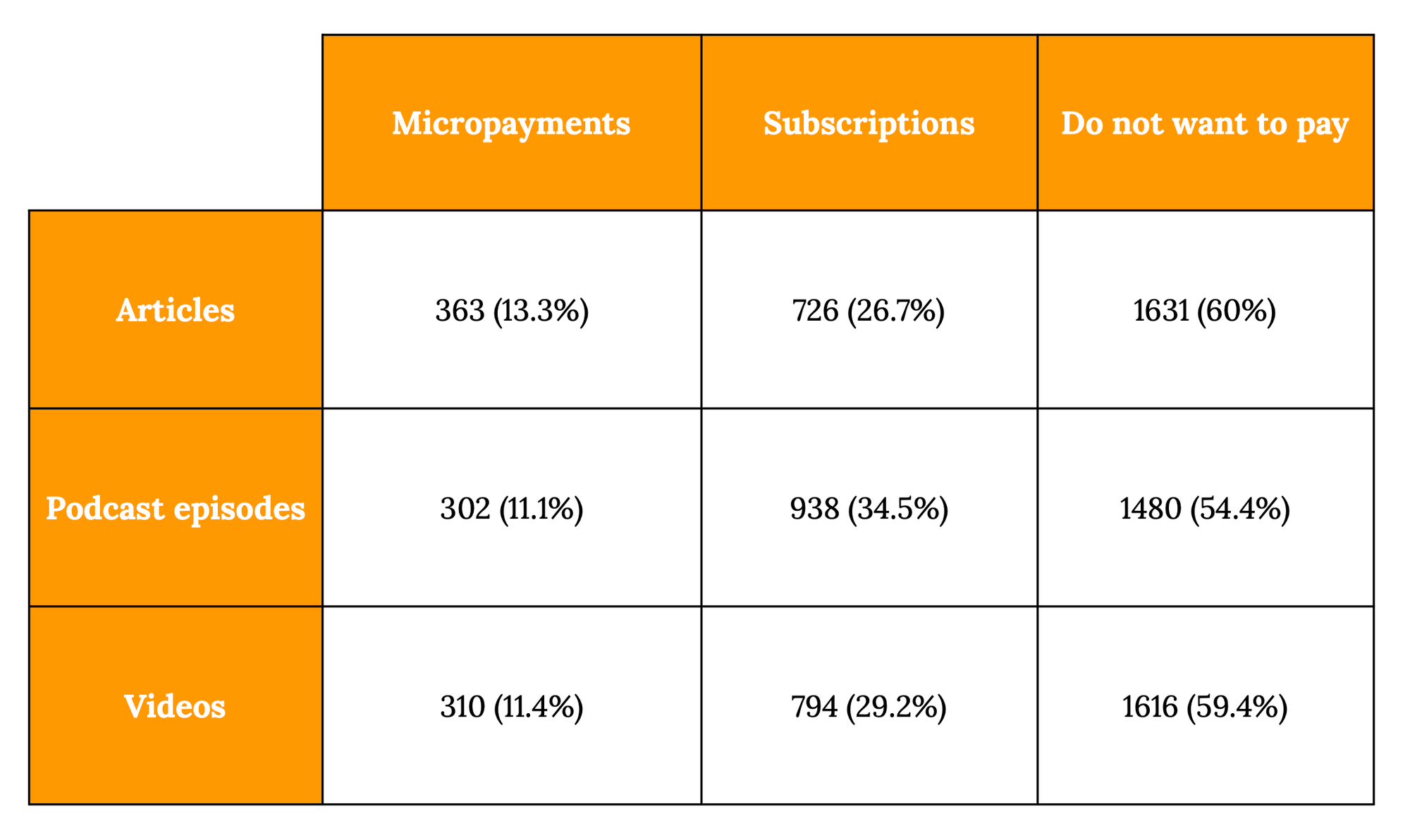
"The analysis finds a clear preference for subscriptions to pay for articles, podcast episodes and videos."
Here are the numbers from the test mentioned above:
Let's visualise that:
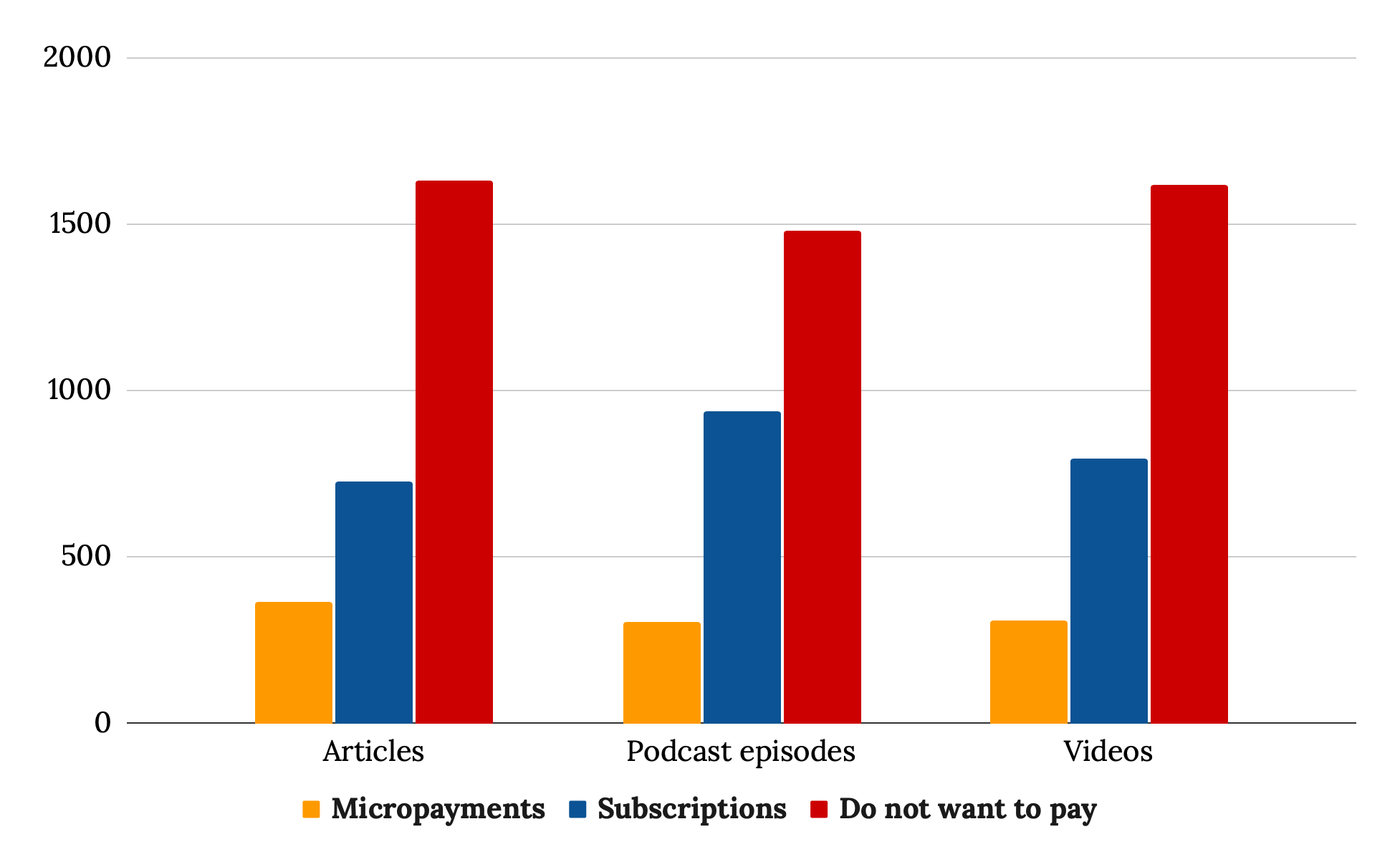
Those red columns reveal a story of their own which we won't spent a lot of time on in this article – again, from the conclusion:
"That said, most respondents express that they do not want to pay at all so even though subscriptions seem like a more viable option for news media than micropayments, there is still a challenge with getting audiences to pay in the first place."
We all knew that, so let's zoom in on the micropayments/subscription part of it and talk about willingness to pay in general some other time 😉
The authors also tried to found out whether various demographics such as age, education or gender might play a part in who prefers what:
"The analysis shows that for all three types of media there are statistically significant but weak negative correlations with both gender and age. This means that women exhibit a significantly stronger preference for micropayments than men, as do older respondents compared to the younger ones. There is also a statistically significant weak negative correlation between preference in paying for a podcast episode and the level of education; this correlation shows that people with a long education are more in preference of micropayments for this type of medium than those with a short education. It should be remembered, however, that the overall preference for micropayments is limited across the three types of media."
Income appeared to have no effect, which is pretty interesting.
Brain tasks
The main reason why micropayments aren't favoured is the "mental transaction costs" associated with them.
- Should I buy this article?
- Is this a fair price?
- Why is that article cheaper?
- Etc.
The term was coined by American computer scientist, legal scholar, and cryptographer (according to his Wikipedia page) Nick Szabo in his seminal 1999 paper, 'Micropayments and Mental Transaction Costs'.
Szabo's thinking relies on economic factors, which makes it ripe for an expansion when applied to media users, the authors argue:
"One such dimension that likely plays an important part is context. In high-choice media environments, the individual media user already spends considerable mental resources deciding which media to use and which pieces of journalism to engage with. If, on top of this, an assessment must also be made as to whether the pieces of journalism are worth the listed price (not to mention the practical way of payment), the mental transaction costs accumulate."
26 years ago
Reading the study reminded me of Clay Shirky's 2000 article on the topic, titled 'The Case Against Micropayments'.
(The article is only accessible via The Internet Archive's Wayback Machine or Shirky's own website, via an insecure HTTP connection (so your browser may stop you), since the original has been removed.)
Interestingly enough, 26 years ago Shirky arrived at the same conclusion (my emphasis):
"Why does it matter that users hate micropayments? Because users are the ones with the money, and micropayments do not take user preferences into account.
In particular, users want predictable and simple pricing. Micropayments, meanwhile, waste the users' mental effort in order to conserve cheap resources, by creating many tiny, unpredictable transactions. Micropayments thus create in the mind of the user both anxiety and confusion, characteristics that users have not heretofore been known to actively seek out."
He explains further (again, my emphasis):
"There is a certain amount of anxiety involved in any decision to buy, no matter how small, and it derives not from the interface used or the time required, but from the very act of deciding.
Micropayments, like all payments, require a comparison: 'Is this much of X worth that much of Y?' There is a minimum mental transaction cost created by this fact that cannot be optimized away, because the only transaction a user will be willing to approve with no thought will be one that costs them nothing, which is no transaction at all.
Thus the anxiety of buying is a permanent feature of micropayment systems, since economic decisions are made on the margin - not, 'Is a drink worth a dollar?' but, 'Is the next drink worth the next dollar?' Anything that requires the user to approve a transaction creates this anxiety, no matter what the mechanism for deciding or paying is."
Shirky describes three payment solutions which he believes will prevail online, which is pretty forward-looking for something written back in 2000 – and can serve as a kind of framework for payment strategies for publishers:
- Aggregation (access to multiple pieces of content – the newspaper is a great example of this, I would argue that a "day pass" with access to an online newspaper is the same, though some might describe it as a micropayment).
- Subscription (we all know how that works, but hardly any online subscriptions existed when Shirky penned his thoughts).
- Subsidy (someone else is picking up the tab – for publishers, advertising is the perfect example).
For now, he appears to be in the right.
What users really want
One thing that struck me while revisiting Shirky's article and Kammer and Spejlborg's study is how the conversation around how users view micropayments have changed.
The 2026 study describes how many may believe that users prefer micropayments over subscriptions (my emphasis):
"Finding limited audience interest in micropayments as a means for paying for online journalism, this study debunks some myths about what audiences want. An understanding has existed that a conflict exists between the news media and its audiences: that while industry actors prefer subscriptions because they are easy to work with and more predictable, audiences would prefer the freedom of choice, the transparency and the reduced costs of micropayments."
Shirky comes from a very different perspective.
He believes that micropayments will fail because users don't want them. They even hate them, he says. The reason for this is that users prefer simplicity, and micropayments are anything but.
He writes:
"Users have no trouble deciding whether a $1 newspaper is worthwhile - did it interest you, did it keep you from getting bored, did reading it let you sound up to date - but how could you decide whether each part of the newspaper is worth a penny?"
The myth that the new study is debunking (that users prefer micropayments, but publishers don't want them) is a direct flip of what Shirky described (my emphasis):
"Unfortunately, the barriers to micropayments are not problems of technology and interface, but user approval. The advantage of micropayment systems to people receiving micropayments is clear, but the value to users whose money and time is involved isn't."
And in terms of the development of markets:
"In situations where there is real competition, providers are usually forced to drop 'pay as you go' schemes in response to user preference, because if they don't, anyone who can offer flat-rate pricing becomes the market leader."
Conclusion
So, what can we learn from all of this?
Well, first and foremost: If you already have a well-performing subscription business running, stick with that and find other ways to diversify your income and value proposition than by micropayments/single payments.
If you are coming from a publication funded through subsidy, like ads, and want to add more revenue streams based on your content, subscription looks like the way to go for most.
Sure, the support for micropayments isn't a stone cold zero. And there may be some income to pick up from single sales, as the Kammer and Spejlborg write:
"The silver lining for micropayments is that even though the audiences most willing to pay prefer subscriptions, some do express an interest in micropayments (as Schrøder et al. 2024 also document). Some industry actors may be able to leverage that interest to generate at least some revenues from non-subscribing audiences in the same way as actors in other sectors, such as gaming, have done earlier. [The Reuters Institute Digital News Report 2024] do find that among those audiences who do not pay for online journalism, between 6 per cent and 21 per cent would be willing to pay a small amount of money for access in the future, and there may be (small but compounding) revenues to collect."
The challenge, if you are already (partly) subscription-funded, is to utilize single payments without cannibalizing your subscription business:
"As subscribers with only light use could be tempted to switch from subscription to micropayments to lower their expenses, news media that introduce micropayments risk collecting pennies at the cost of dollars."
Here in Denmark, the publication Mandag Morgen have earlier learned that even at a price of 150 Danish kroner (roughly 22 US dollars) micropayments would undermine their subscription model, as editor-in-chief Jakob Nielsen wrote in a 2018 tweet.
So if you dare to enter into micropayment land, handle with care. And you would do well by having a clear plan on how to convert single-purchasing customers into paying subscribers at some point.
For now, we could probably do better by thinking about how to address the people who decline to pay for news/journalism at all.
Agents incoming
There is, however, a thought that keeps lingering at the back of my head:
Will all of this change in a not too distant future with AI agents browsing, accessing and pulling content on behalf of consumers who would rather have some AI service gather information for them than go to publishers' websites?
In September last year (2025) Google announced the Agent Payments Protocol (AP2), "an open protocol for the emerging Agent Economy [...] in collaboration with Coinbase and over 60 organizations".
From the AP2 documentation (my emphasis):
"Large enterprises and consumer platforms are already rolling out task-specific agents—handling procurement, partner onboarding, customer support, research, and logistics. Until now those agents could recommend vendors and draft purchase orders but needed a human to approve and pay. AP2 closes that gap:
- Agents can publish their services with transparent pricing, SLAs, and dispute policies.
- Buyer agents can negotiate terms, execute a payment, receive a tamper-proof receipt, and trigger downstream systems.
- Micro-tasks and usage-based services can settle instantly, enabling entirely new marketplaces for machine-to-machine commerce."
Whether this can make single purchases work in the media industry will probably remain a "let's wait and see", although the agentic approach could possibly lower some of the mental transactions costs for the customers.
The economics for the publishers involved, however, might not look so favourable – as with so many other things at the moment 🫤
Additional reading:
Clay Shirky would revisit the topic in his 2009 article 'Why Small Payments Won’t Save Publishers', with thinking shaped by the Web 2.0 revolution which had started since his first article:
"Meanwhile, back in the real world, the media business is being turned upside down by our new freedoms and our new roles. We’re not just readers anymore, or listeners or viewers. We’re not customers and we’re certainly not consumers. We’re users. We don’t consume content, we use it, and mostly what we use it for is to support our conversations with one another, because we’re media outlets now too. When I am talking about some event that just happened, whether it’s an earthquake or a basketball game, whether the conversation is in email or Facebook or Twitter, I want to link to what I’m talking about, and I want my friends to be able to read it easily, and to share it with their friends. "
Kammer and Spejlborg argue (as I briefly touched upon in the beginning of this post) that "micropayments" might not be the best term (my emphasis):
"Furthermore, there is some terminological housekeeping to be done in academia and the industry. Is the term ‘micropayments’ really the most appropriate one within the context of news and journalism? The size of the payment need not be microscopic (and, in the industry examples of micropayment applications, it has rarely been), and it is, ultimately, not the size of the payment that defines the phenomenon in question. Rather, what is important is the unbundling of online journalism so that individual articles or pieces of content are available upon payment. Therefore, there is reason for terminological calibration. In this article, we have aligned ourselves with the existing scholarly literature, but the terms ‘single payment’ and ‘one-off payment’ may be more appropriate."
I've arrived at something similar [article in Danish] some years ago – after taking part in a conversation on Twitter started by Aske Kammer, funny enough.
Back in 2018 (which is where my post linked to just above is also from) there were a lot of discussions on micropayments in the Danish media industry, which led Claes Holtzmann (Head of Data and Analysis at JFM, Denmark's second largest publisher – and a former guest in this newsletter) to do a very thorough Twitter thread on the topic.
It's probably as close as you'll ever get to a must-read on micropayments in the media industry.
Danish media analyst Thomas Baekdal has written about micropayments several times – recently in a four months old LinkedIn post about how the topic keeps coming back:
"So, please, people. Can we please stop this nonsense. I have been having this discussion around micropayments for 25 years now. It does not work, nor will it ever work."
Other articles from Baekdal:
- Let's Create a Real Micro-Payment System (2011)
- We Need To Drastically Simplify Payments Online (2012)
Thank you for your time and attention.
My name is Lars K Jensen, and I work with journalism, editorial insights and digital development as the Editorial Development Lead at Berlingske Media in Denmark. This is my personal newsletter.
Feel free to connect on LinkedIn and say hi.